...redirecting
Brain Friendly AI
Most AI training teaches your team to work faster with AI. This workshop teaches them to stay sharp while doing so.
A practical workshop
Your teams learn to make better choices about what to delegate to AI and where to stay in charge. Using situations from their own working day, they learn to use AI consciously. Participants leave with a personal AI assessment, a delegation compass, three concrete team agreements on AI use and a 48-hour challenge.
Who’s in control?
Are you keeping yourself and your team in the loop, or in the lead?
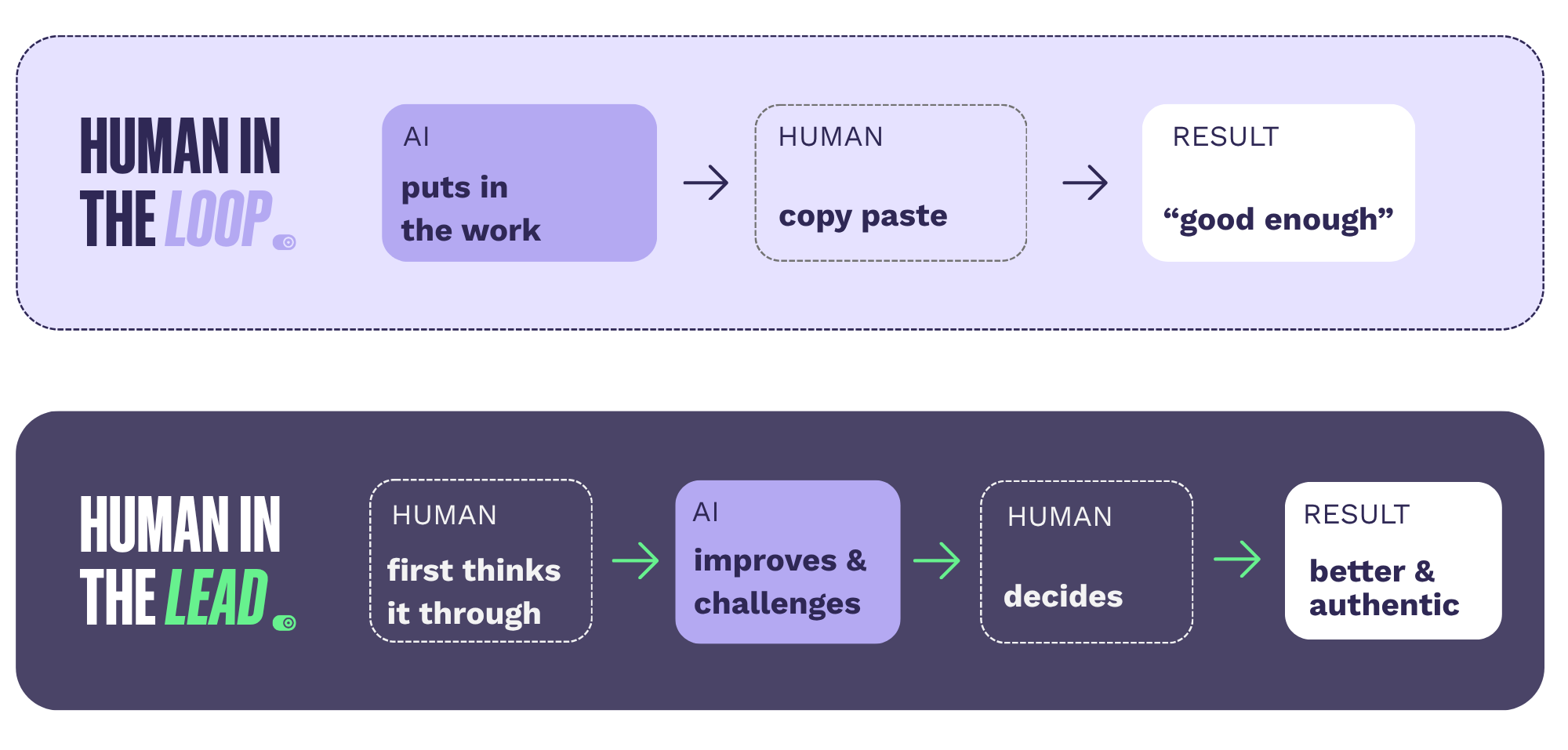
Thinking critically, understanding problems in depth, thinking creatively: these skills only stay strong if you keep practising them, even with AI at your fingertips. That’s what this workshop is all about.
Why does this matter?
Organisations everywhere are investing in AI without investing in the people who direct it, leaving them feeling increasingly directed by it instead. The biggest concern? AI may make your team faster, but recent research shows that speed can come at a price.
- In a global study of senior executives, half already see a decline in thinking skills within their own organisations (BCG).
- In a 2025 survey, 40% of US office workers said they had received “workslop” in the previous month: AI-generated work that looks good but doesn’t hold up. The cost goes beyond lost time: trust between colleagues suffers too (Stanford University and BetterUp).
- Among around 1,500 employees, roughly one in seven experienced mental exhaustion from constantly switching between AI tools, with greater decision fatigue and more mistakes. Using AI consciously for repetitive tasks, however, reduced stress, while leadership and training also helped (Harvard Business Review).
- Doctors who performed colonoscopies with AI assistance for three months subsequently detected fewer polyps when working without it: detection rates fell from 28% to 22%. This is the first documented indication of AI-related “deskilling” in healthcare (The Lancet).
More and more employees are also carrying a question they rarely voice: will I remain relevant? Employers who address it build trust, engagement and the ability to attract and retain talent.
Springboard or substitute?
- A cognitive substitute thinks for you. You get an immediate answer, but you don’t practise the skill behind it.
- A cognitive springboard starts where your thinking stops. You create your own version first. Then you use AI to develop it further, challenge it and reveal what you’ve missed.
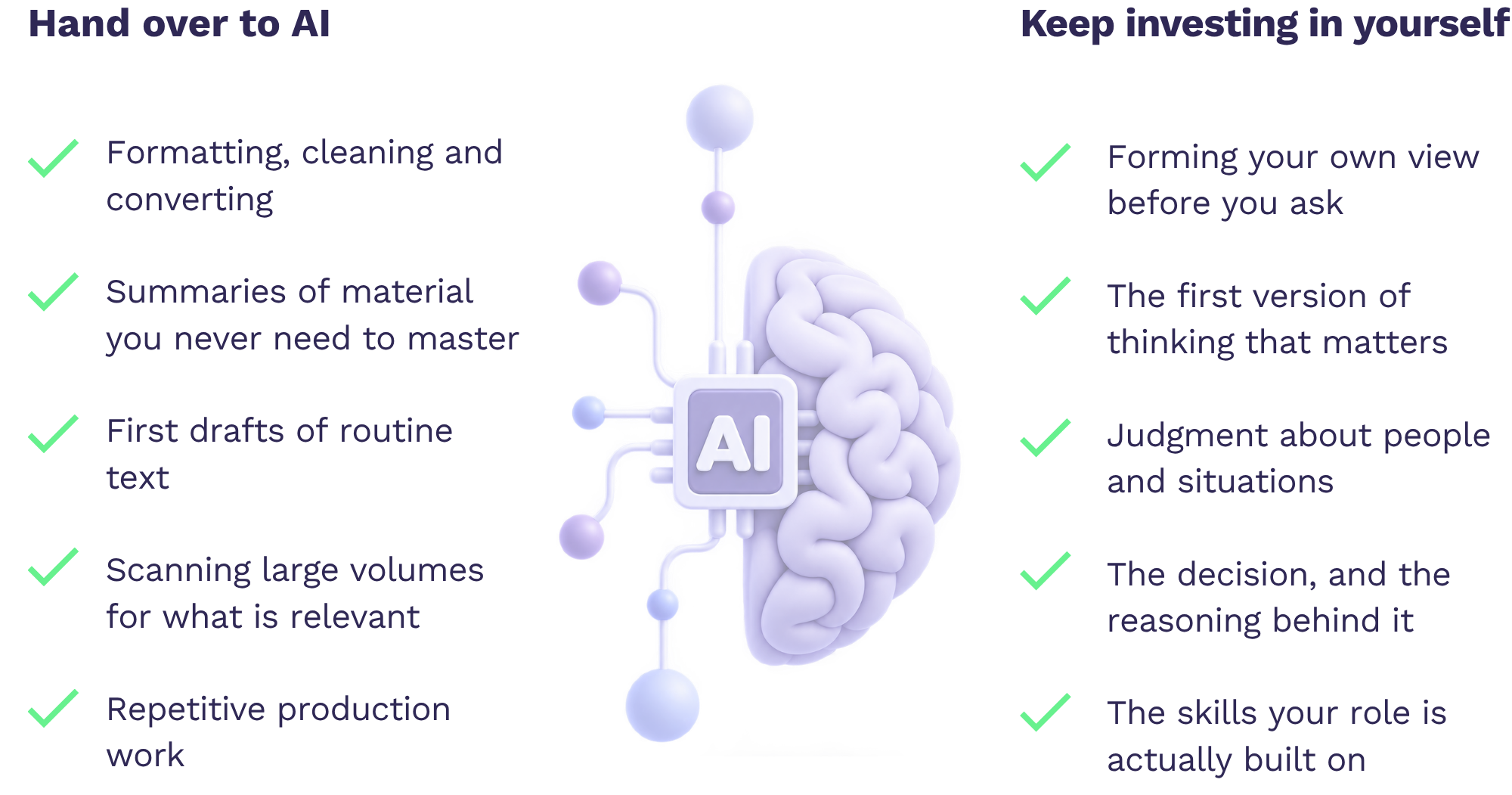
A question to start with
- Which tasks have you already mastered and can confidently delegate?
- Which tasks help you grow and are best kept in your own hands?
Together, we explore the answers that fit your teams and tools beforehand, ensuring the workshop is fully tailored to your day-to-day work.
Who is this workshop for?
For teams and organisations already using AI every day who notice that the pace is picking up, but depth doesn’t always keep up. Take a deliberate approach to how your team works with AI, with conscious choices and concrete agreements.
Want to make an even greater impact?
The workshop is based on De Mentale Revolutie, the new book by Dr. Elke Geraerts (Lannoo, February 2027).
Combine it with the keynote of the same name to kick things off for a wider audience, followed by workshops in teams.

Workshop: 2 hours - half a day
Workshop: up to 25 per trainer, scalable across teams
Via open inschrijvingen bieden we opleidingen aan voor professionals die willen groeien, in kleine groepen met uitwisseling tussen deelnemers uit diverse organisaties.
What your team will take away:
By the end of the workshop:
- Each participant has a personal AI assessment identifying the two habits they will change first.
- Each participant has a completed delegation compass: what to delegate, what to keep doing themselves and why.
- Everyone has dedicated focus blocks scheduled for the following week.
- The team has three agreements on AI use that they have created together and committed to.
- A 48-hour challenge is underway, immediately turning learning into action.

“"Better Minds at Work heeft me geholpen om het werk te hervatten na een lange burn-out. Met de juiste tools om herval te voorkomen, voel ik me sterker dan ooit!"”
Let’s get Started
Or contact us for more information

Looking for a tailor-made programme that fits with your budget and needs?
Whether you're ready to get started or want to learn more about our programmes, our team is here to help. Connect with us today and discover how we can elevate your team’s culture, well-being, talent, and leadership.